White House / President·Gun Rights
Reps. Cloud and Clyde urge Trump and Vance to investigate ATF’s 1.4 billion pages of out-of-business gun records
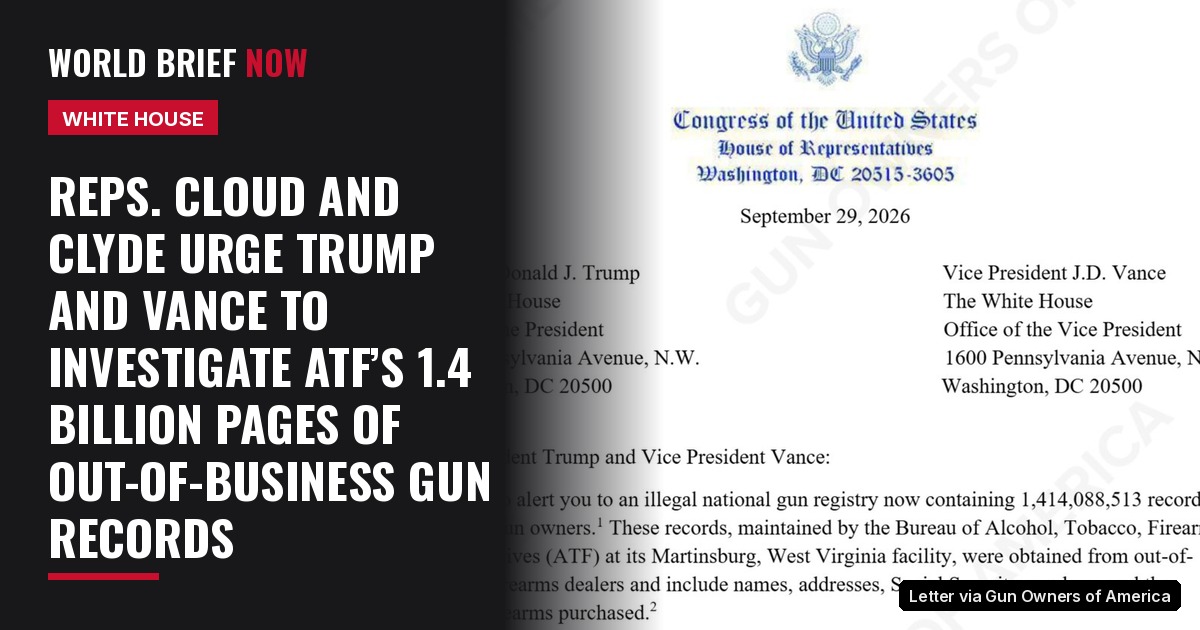
Reps. Michael Cloud of Texas and Andrew Clyde of Georgia asked President Trump and Vice President Vance in a letter dated Sept. 29 to order an “immediate, independent investigation” of the Bureau of Alcohol, Tobacco, Firearms and Explosives’ out-of-business records, which the letter calls “an illegal national gun registry now containing 1,414,088,513 records of guns and gun owners.” The letter also asks for “the prompt and verifiable destruction” of any records kept in violation of the Firearm Owners’ Protection Act of 1986 and appropriations limits, and for any final ATF record-retention rule to comply with those limits. Cloud posted the letter on X on Tuesday; Gun Owners of America posted it earlier in the day. ATF told Cloud in June that its tally of 1,414,088,513 counts scanned images and paper pages, and that the images cannot be searched by a buyer’s name.
What the Letter Asks
- 1. Investigate
- “Direct an immediate, independent investigation of ATF’s Martinsburg database.”
- 2. Destroy
- “Order the prompt and verifiable destruction of any records maintained in violation of the 1986 Firearm Owners Protection Act and the appropriations prohibitions.”
- 3. The new rule
- “Ensure that any final rule on record retention fully complies with those same prohibitions.”
The two Republicans listed three requests after writing, “Congress has already spoken. The American people need executive action to enforce that law.”
A Question About Convictions
In a separate paragraph, the lawmakers said that “although we appreciate the reporting on gun traces conducted during investigations, we’d like to know the specific number of traces that have led to a criminal conviction, and a few examples of such cases.” The letter closes: “We ask for your decisive leadership to end this registry and prevent its expansion.”
What the Letter Says
The letter says the records, “maintained by” ATF “at its Martinsburg, West Virginia facility, were obtained from out-of-business firearms dealers and include names, addresses, Social Security numbers, and the specific firearms purchased.” Federal law requires dealers that go out of business without a successor to send their records to ATF within 30 days.
It says the 1986 law prohibits “any system of registration of firearms, firearms owners, or firearms transactions,” that appropriations riders “bar the ATF from centralizing these records and searching them by name,” and that the collection has grown “from roughly 920 million records in 2021 to more than 1.4 billion today.”
It cites a 2022 Gun Owners of America report as showing the records “can be searched and filtered by make, model, and firearm type,” and says President Biden’s ATF director, Steven Dettelbach, “even admitted to circumventing these protections.” A footnote quotes Dettelbach telling Clyde that ATF is “the only customer that pays additional money to have search function taken out of Adobe Acrobat” and, “We search by serial numbers.”
The letter also quotes Vance: “This database is ultimately a back door to a gun registry in this country. … once you allow a gun registry, you effectively allow the disarming of your citizenry. This is ultimately about destroying the Second Amendment.”
Where the 1.4 Billion Figure Comes From
The number matches a chart in a June 10 letter ATF sent to Cloud, which Cloud’s letter does not link: its first footnote reads only “LINK TO RECENT ATF LETTER.” The chart lists “estimated out of business FFL record counts” as of May 19: 912,184,571 images in ATF’s main image system, 397,009,542 images converted from microfilm and microfiche, and 104,894,400 paper pages waiting to be scanned, for a total of 1,414,088,513 “images/pages.” ATF’s note says an image equals “a single one-sided page of a document,” so the figure counts pages, not gun sales or gun owners.
In the same letter, ATF said the records are stored as “non-searchable, static images,” indexed by the dealer’s license number and “in limited cases” by details such as a serial number. It said it does not use character recognition to capture buyers’ names and “does not have the capability to conduct a search” of the records “by an individual’s name or other personally identifiable information.” GOA’s 2022 report argued otherwise, saying files pass through searchable formats during scanning and that name search is disabled, not impossible.
ATF defended the records as a tracing tool. It said 51.39 percent of the 10.2 million traces it handled from 2000 through 2025 were completed using out-of-business records, and that its tracing center used them to trace the firearm used in the July 2024 attempt on Trump’s life within 30 minutes. The gun had been bought 11 years earlier from a business that no longer exists, ATF said.
The 2021 figure comes from GOA’s 2022 report, which says ATF told Cloud and other House members that it held 920,664,765 records as of November 2021, of which 865,787,086 were digitized.
The ATF Rule the Letter Cites
The rule, RIN 1140-AA95, is titled “Firearm Records Retention Periods.” It is still a proposal. ATF published it in the Federal Register on May 6, and public comments closed Aug. 4. No final rule had been published when we checked the Federal Register on Wednesday.
Today, dealers must keep their sales records and Forms 4473 until they go out of business, a requirement dating to a 2022 rule, and ATF keeps out-of-business records indefinitely. The proposal would set a time limit on both; ATF says it is considering either 20 or 30 years. Dealers would keep records “for no less than 20 [or 30] years” from a sale, and ATF “will retain records delivered to and maintained at ATF’s Out-of-Business Records Center for no longer than 20 [or 30] years from the date they receive the records.” Dealers that close would still have to send their records to ATF, as they must now.
The letter describes the rule differently. It says the rule “would require dealers to retain transaction records for up to 30 years and then transfer them to ATF for another 30 years.” The proposal sets a minimum, not a maximum, for dealers, and it does not require any dealer to hand records to ATF after a set number of years. Under the proposal, as now, dealers send their records to ATF when they go out of business. The proposal says the change “would significantly reduce the volume of records retained by ATF.”
Clyde and 28 other House members made a related argument in an Aug. 5 letter to ATF Director Robert Cekada: a record kept up to 30 years by a dealer and another 30 by ATF could be held for as long as 60 years. They urged a 20-year limit in total. In its June letter, ATF told Cloud the proposal grew out of the review ordered by Trump’s 2025 executive order on Second Amendment rights.
What the Law Says
The registry ban is real and is in 18 U.S.C. 926(a), added by the Firearm Owners’ Protection Act. It says no rule or regulation issued under the federal gun law after the 1986 act may require that dealers’ records “be recorded at or transferred to a facility owned, managed, or controlled by the United States,” nor that “any system of registration of firearms, firearms owners, or firearms transactions or dispositions be established.” (The letter’s quotation leaves out the words “or dispositions.”)
The riders are real, too. In the 2012 spending law, Congress made permanent a ban on spending money “in connection with consolidating or centralizing, within the Department of Justice,” dealers’ records, and a ban on using funds “to electronically retrieve” out-of-business records “by name or any personal identification code.”
A 2016 Government Accountability Office review found that ATF’s out-of-business imaging system “complies with the restriction” on centralizing records. It found that two other ATF data systems “did not always comply,” and said ATF fixed those problems during the review.
The Quotes, Checked
- Vance
- The letter does not give a date. Fox News posted the remarks on Feb. 4, 2022, when Vance, then a U.S. Senate candidate in Ohio, spoke on “Tucker Carlson Tonight” about a report that the Biden administration had nearly 1 billion records of gun purchases. Fox’s transcript matches the letter’s wording closely (Fox has “once you allow gun registry”), and the letter leaves out what Vance said next: “just as the Democrats’ alliance with Big Tech is about destroying the First Amendment.” He then asked, “Why don’t we just get rid of the ATF?”
- Dettelbach
- The Epoch Times reported the “Adobe Acrobat” remark from an April 18, 2023, House Appropriations subcommittee hearing, when Clyde asked whether ATF’s records database is searchable. We could not confirm the “We search by serial numbers” line in the footnote. The letter cites a GOA post of a 32-second clip, and we did not find an official transcript of the hearing.
Who Signed, and Where It Was Posted
The two pages posted online carry two signatures, Cloud’s and Clyde’s, on House letterhead. Gun Owners of America posted them on X at 11:59 a.m. CT Tuesday, saying “24 Congressmen” had sent the letter. Clyde shared GOA’s post at 3:56 p.m. CT with the comment, “The ATF’s illegal gun registry must be destroyed—ASAP.” Cloud posted the same two pages at 5:37 p.m. CT: “Today I sent a letter to President Trump and Vice President Vance urging action against ATF’s unlawful gun registry.” Neither lawmaker’s post, nor the posted pages, names any other signer. As of 12:20 p.m. CT Wednesday, the letter was not on Cloud’s or Clyde’s House website. Just the News reported on the letter in a story dated Sept. 29, describing it as Cloud’s.
The letter closely tracks one that eight Republican senators, led by Idaho’s Jim Risch, sent Attorney General Todd Blanche on Sept. 24. That version adds a line saying the White House has described the records as an “invasive database.”
Response
As of 12:20 p.m. CT Wednesday, we had found no public response to the letter from the White House, the Justice Department or ATF. AmmoLand News reported Tuesday that Blanche had not publicly answered the senators’ letter.
Credits
Lead image: the first page of the letter as posted by Gun Owners of America on X, Sept. 29, 2026 (cropped). Quotes from the letter are from the images posted by GOA and by Rep. Cloud, which match word for word.
- Rep. Michael Cloud (@RepMichaelCloud) on X“Today I sent a letter to President Trump and Vice President Vance…” with both pages of the letter (Sept. 29, 5:37 p.m. CT)
- Gun Owners of America (@GunOwners) on X“24 Congressmen just sent an urgent message to @POTUS & @JDVance” with both pages of the letter (Sept. 29, 11:59 a.m. CT)
- Rep. Andrew Clyde (@Rep_Clyde) on X“The ATF’s illegal gun registry must be destroyed—ASAP.” (Sept. 29, 3:56 p.m. CT)
- ATF (letter to Rep. Cloud, as posted by AmmoLand News)Response on out-of-business records, with record counts as of May 19, 2026 (June 10, 2026)
- Federal RegisterFirearm Records Retention Periods, 91 FR 24413 (proposed rule, May 6, 2026)
- ATFFirearm Records Retention Periods (RIN 1140-AA95)
- Reginfo.gov (OMB)Unified Agenda entry, RIN 1140-AA95: Proposed Rule Stage
- U.S. House, Office of the Law Revision Counsel18 U.S.C. 926, Rules and regulations
- GovInfoConsolidated and Further Continuing Appropriations Act, 2012 (Public Law 112-55)
- U.S. Government Accountability OfficeGAO-16-552, Firearms Data: ATF Did Not Always Comply with the Appropriations Act Restriction (2016)
- Fox NewsJD Vance argues to get rid of the ATF, says a gun registry is ‘disarming’ citizens (Feb. 4, 2022)
- Gun Owners of America (@GunOwners) on XVance clip cited in the letter (July 19, 2024)
- Gun Owners of America (@GunOwners) on XDettelbach hearing clip cited in the letter (April 18, 2023)
- The Epoch TimesRepublicans Accuse ATF of Overreach During Budget Hearing (April 2023)
- Gun Owners of AmericaATF’s Illegal Gun Owner Registry, by Aidan Johnston (May 2022)
- Rep. Andrew ClydeRep. Clyde Urges ATF to Limit Firearm Record Retention and Destroy Illegal Gun Registry (Aug. 5, 2026)
- Sen. Jim RischLetter to Attorney General Todd Blanche (Sept. 24, 2026)
- Sen. Jim RischRisch Urges DOJ to Investigate ATF’s Illegal Gun Registry (Sept. 24, 2026)
- Just the NewsExclusive: Feds hold 1.4 billion gun records on Americans, congressman asks Trump to protect privacy (Sept. 29)
- AmmoLand NewsSenators Demand Destruction of ATF’s 1.4 Billion Gun Records (Sept. 29)