World·Hawaii volcano
Kilauea's north vent keeps overflowing as USGS says 'Episode 55 remains a possibility'
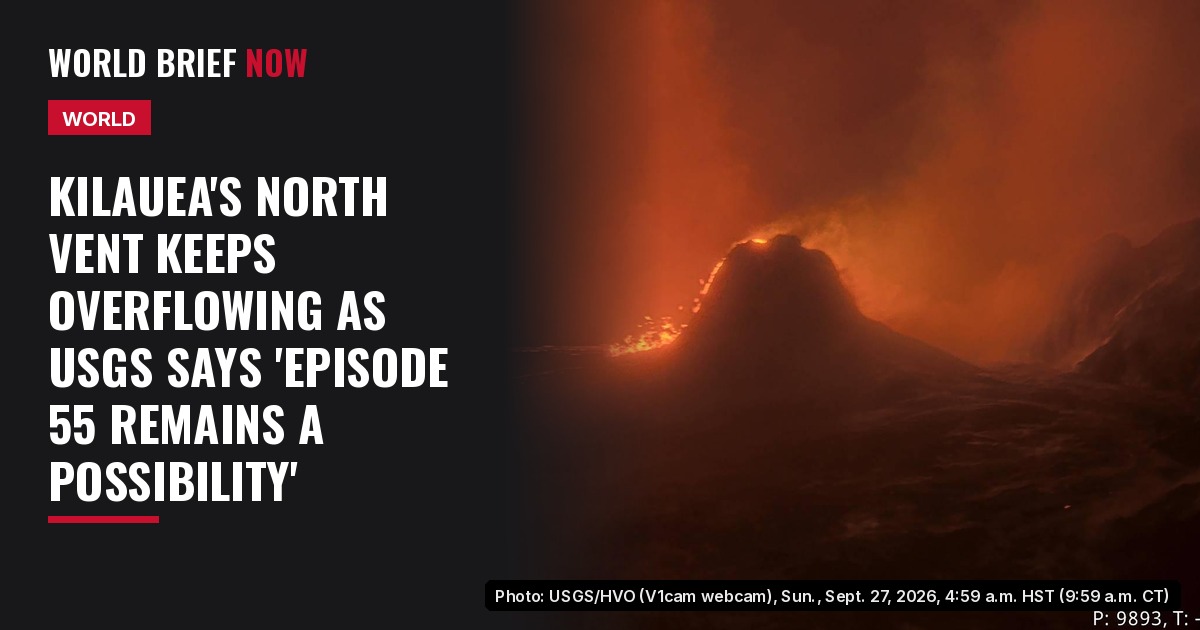
Small lava overflows from Kilauea's north summit vent continued for a fourth day, USGS said; the volcano remains at alert level WATCH, aviation code ORANGE. Status in this story is as of the latest USGS daily update, issued Saturday, Sept. 26, 2026, at 8:41 a.m. HST (1:41 p.m. CT).
Status as of the latest USGS daily update
- Latest USGS daily update
- Sat., Sept. 26, 2026, 8:41 a.m. HST (1:41 p.m. CT)
- Volcano Alert Level
- WATCH
- Aviation Color Code
- ORANGE
- USGS summary
- “Small overflows from the north vent continue for the fourth day. All vents have strong glow, with overflows and intermittent spatter from the north vent. There is no anomalous activity outside of the summit.”
- Latest HVO short message
- Sat., Sept. 26, 8:56 p.m. HST (1:56 a.m. CT Sunday): 8 more north-vent overflows since that morning’s update
- Sunday daily update
- Not yet issued by HVO as of 10:58 a.m. CT Sunday, Sept. 27
The latest
Lava kept spilling in small overflows from the north vent at the summit of Kilauea on the Island of Hawaiʻi through Saturday evening, according to the U.S. Geological Survey's Hawaiian Volcano Observatory (HVO).
“Small overflows from the north vent continue for the fourth day,” HVO said in its most recent daily update, issued Saturday, Sept. 26, at 8:41 a.m. HST (1:41 p.m. CT). The observatory said “Episode 55 remains a possibility during the ongoing Kīlauea summit eruption.” USGS lists Kilauea's Volcano Alert Level as WATCH and its Aviation Color Code as ORANGE.
In a short message posted at 8:56 p.m. HST Saturday (1:56 a.m. CT Sunday), HVO said: “There have been 8 more overflows from the north vent since the Kīlauea daily update was released at 9 am HST this morning. Tilt and tremor remain constant. Inflation remains high. Steam and clouds continue to obscure the vents.” HVO had not issued its Sunday daily update as of 10:58 a.m. CT Sunday.
According to Saturday's update, the overflows resumed at 10:10 p.m. HST on Sept. 22, and HVO had counted 33 by the time of that update. Most lasted about 10 to 35 minutes, sending lava a few hundred meters (yards) from the vent.
The summit recorded about 0.8 microradians of inflation over the day, bringing total inflation since the end of episode 54 to about 16.8 microradians, HVO said. Episode 54, on Aug. 25, produced nine hours of lava fountaining that reached about 500 feet (150 meters).
HVO cautioned that “it is not possible to say with certainty that this activity will lead to the onset of another fountain event at this time, although conditions remain favorable.” It reported no significant activity in Kilauea's East Rift Zone or Southwest Rift Zone.
Background
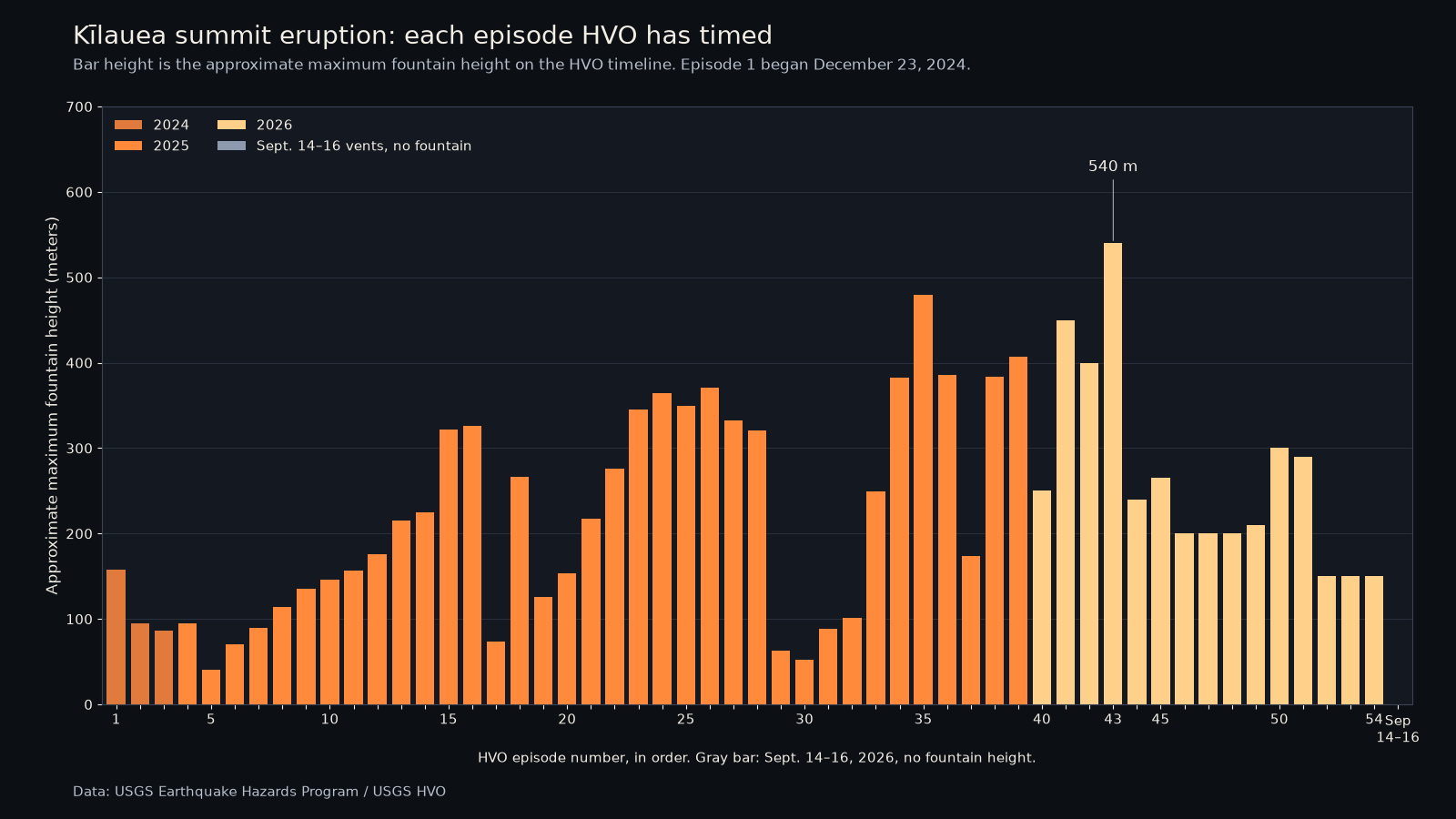
The current summit eruption began at 2:20 a.m. HST on Dec. 23, 2024 (6:20 a.m. CT). HVO's timeline of eruptive episodes lists 54 lava-fountaining episodes since then. Episode 54 ended at 7:33 p.m. HST on Aug. 25, 2026, and the timeline still lists the pause that followed as “TBD.”
The tallest fountain on the timeline is about 540 meters (about 1,770 feet), in episode 43 on March 10, 2026. USGS lists that fountain as 1,772 feet (540 meters) above vent level.
Measured from the start and end times on HVO's timeline, the 53 pauses between episodes averaged about 10.8 days, by World Brief Now's calculation. The current pause has now lasted more than 32 days since episode 54 ended on Aug. 25. The longest completed pause on the timeline, after episode 43, is listed by HVO as 30 days.
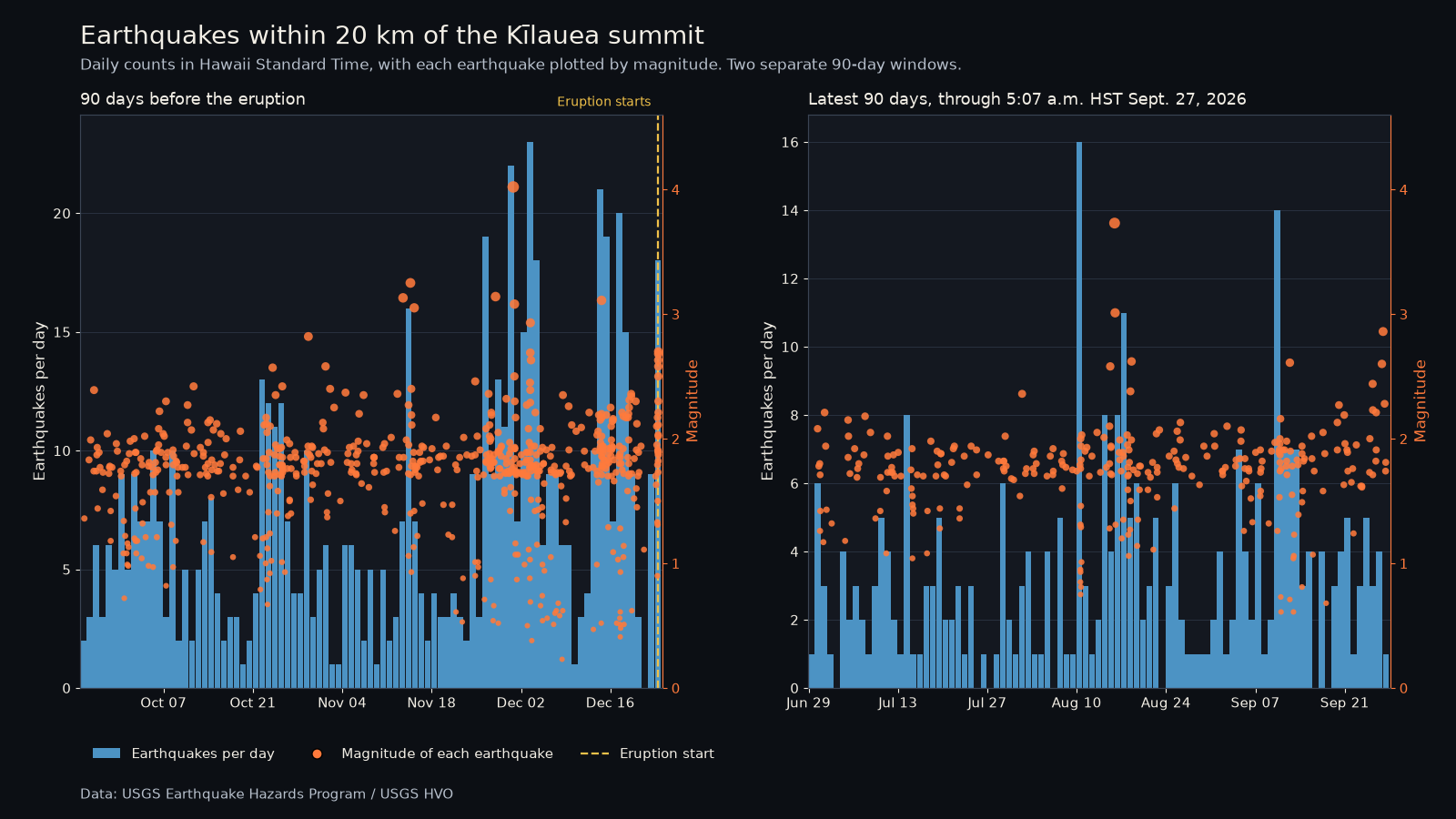
Earthquakes: World Brief Now searched the USGS earthquake catalog for all earthquakes within 20 kilometers (about 12 miles) of a point at Kilauea's summit (19.406° N, 155.283° W). In the 90 days before the eruption began, from 2:20 a.m. HST Sept. 24 to 2:20 a.m. HST Dec. 23, 2024, the catalog lists 643 earthquakes; the largest was magnitude 4.02, on Nov. 30, 2024. In the latest 90 days, from 5:07 a.m. HST June 29 to 5:07 a.m. HST Sept. 27, 2026, the same search returns 296 earthquakes; the largest was magnitude 3.73, on Aug. 15, 2026.
Those totals are World Brief Now's counts from the catalog as retrieved Sept. 27, 2026, not figures published by USGS. They include all magnitudes and both reviewed and automatic (preliminary) catalog entries, and they can change as USGS reviews events.
Charts
- Chart: Fountain height for each episode Approximate maximum fountain height for each of the 54 lava-fountaining episodes on HVO's timeline since Dec. 23, 2024. The tallest, about 540 meters (about 1,770 feet), was episode 43 on March 10, 2026. The gray bar marks new vents that erupted Sept. 14–16, 2026, without fountaining. Chart: World Brief Now; data: USGS/HVO.
- Chart: Earthquakes near the summit, two 90-day windows Daily earthquake counts (bars) and the magnitude of each earthquake (dots) within 20 km (about 12 miles) of Kilauea's summit, in Hawaii Standard Time. Left: the 90 days before the eruption began (Sept. 24–Dec. 23, 2024; 643 earthquakes, largest M4.02). Right: the latest 90 days through 5:07 a.m. HST Sept. 27, 2026 (296 earthquakes, largest M3.73). Chart: World Brief Now; data: USGS/HVO (USGS earthquake catalog).
Hazards
HVO says the eruption is occurring within a closed area of Hawaiʻi Volcanoes National Park. Hazards it lists include volcanic gas, with sulfur dioxide emissions typically between 1,000 and 5,000 tonnes per day during pauses, and vog downwind. It also warns of tephra, such as Pele's hair, which can cause skin, eye and respiratory irritation.
Saturday's update also said Hurricane Nolo was bringing rain and winds to the island, that poor weather had “greatly reduced visibility” on public webcams, and that the park “remains closed today.”
- USGS Hawaiian Volcano ObservatoryDaily Update, Kilauea, Sat., Sept. 26, 2026, 8:41 AM HST
- USGS Hawaiian Volcano ObservatoryObservatory Messages (Kilauea message 2026-09-26 20:56:49 HST)
- USGSKīlauea Eruption Information: Timeline of Eruptive Episodes
- USGSEarthquake catalog count: 20 km of 19.406 N, 155.283 W, Sept. 24-Dec. 23, 2024
- USGSEarthquake catalog count: 20 km of 19.406 N, 155.283 W, June 29-Sept. 27, 2026
- USGSM 4.0 - 17 km WNW of Volcano, Hawaii (Nov. 30, 2024)
- USGSM 3.7 - 11 km SSW of Volcano, Hawaii (Aug. 15, 2026)
- USGSKīlauea volcano page
- USGSKīlauea summit webcams (V1cam image)
- USGSHANS elevated volcano status
- National Park ServiceHawaiʻi Volcanoes National Park