World·Space
Voyager 1 reaches one light-day from Earth, the first human-made object ever to travel so far
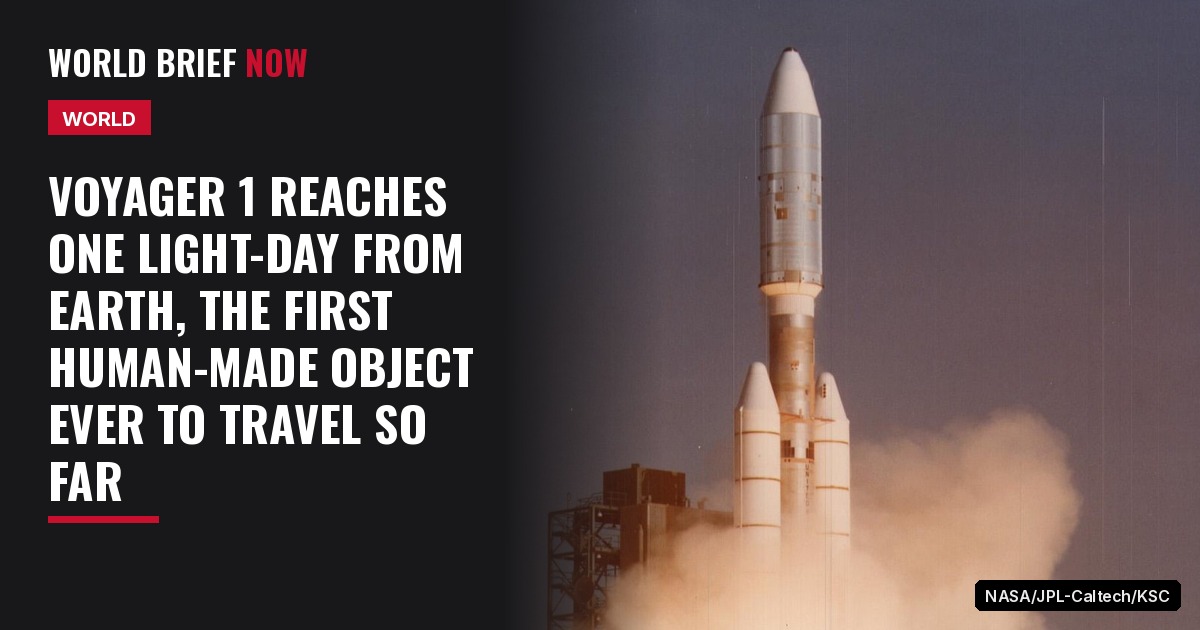
NASA’s Voyager 1 spacecraft reached one light-day from Earth at 5:16:07 a.m. EST on Wednesday, Nov. 18, according to NASA, becoming the first human-made object to travel that far. A light-day is the distance light covers in 24 hours, which NASA puts at about 16.09 billion miles (about 25.9 billion kilometers). The probe got there 49 years, two months and 11 days after its 1977 launch, and it is still sending science data home from interstellar space.
A mile marker no spacecraft has passed
NASA had calculated the moment in advance: at 5:16:07 a.m. EST on Nov. 18, 2026, Voyager 1 would be 16.094 billion miles (25.902 billion kilometers) from Earth, the distance light travels in 24 hours. NASA describes it as a mile marker reached by no other human-made object.
A light-day measures distance, not time. Light moves at about 186,000 miles per second; at that speed it crosses from the Moon to Earth in about 1.3 seconds and from the Sun in about eight minutes and 20 seconds. Voyager 1, moving at roughly 38,000 mph, needed 49 years, two months and 11 days to put one light-day behind it, NASA said.
The practical effect is on the conversation. Commands from NASA’s Deep Space Network now take 24 hours to reach the probe, and its answers take another 24 hours to arrive. “If you want to say ‘hello’ to Voyager, you send your message and then you go home and you wait two days before you finally get a response,” Suzanne Dodd, Voyager project manager at NASA’s Jet Propulsion Laboratory, said in an Oct. 29 JPL release.
Nothing changes aboard the spacecraft at the line, and it will detect no change in its surroundings, according to JPL. The agency said the milestone’s significance lies in what it shows about the vastness of space and the endurance of the probe. NASA marked the occasion by inviting people around the world to shine lights toward the sky after sunset on Nov. 17.
From Florida to interstellar space
Voyager 1 launched on Sept. 5, 1977, atop a Titan IIIE-Centaur rocket from Launch Complex 41 at Cape Canaveral, Florida, about two weeks after its twin, Voyager 2. On a faster route, it overtook Voyager 2 on Dec. 15, 1977.
It made its closest pass of Jupiter on March 5, 1979, discovering a faint ring and two small moons, Thebe and Metis. At Saturn, on Nov. 12, 1980, it found five new moons and a new ring, and it studied Titan’s thick atmosphere, which it found is mostly nitrogen. It then headed north out of the plane of the planets. Before its cameras were switched off in February 1990, it took a final mosaic of the solar system that included the image of Earth known as the “Pale Blue Dot.”
On Feb. 17, 1998, Voyager 1 passed Pioneer 10 to become the most distant human-made object. The Voyager team dates its exit from the heliosphere, the bubble of particles and magnetic fields blown out by the Sun, to Aug. 25, 2012, when its particle readings changed abruptly and for good. NASA announced on Sept. 12, 2013, after studying plasma-wave readings, that Voyager 1 had become the first human-made object in interstellar space. Voyager 2 has since joined it, and the twins remain the only spacecraft ever to operate there.
The probe is headed toward a star called Gliese 445 in the constellation Ursa Minor and is expected to pass within about 1.7 light-years of it in about 40,000 years. NASA expects Voyager 2 to reach one light-day from Earth in November 2035.
Still working, on a shrinking budget of power
Voyager 1 runs on radioisotope thermoelectric generators, which turn heat from decaying plutonium into electricity. Each Voyager loses about 4 watts a year, JPL says, and the team has spent years shutting down systems to keep the rest running.
The spacecraft launched with 10 dedicated science instruments. According to NASA’s instrument status table, two remain on: the magnetometer and the plasma wave subsystem. The cosmic ray subsystem was turned off to save power on Feb. 25, 2025, and the low-energy charged particles instrument on April 17, 2026.
In early September, engineers switched off three devices that help keep the spacecraft warm and replaced them with three lower-power alternatives, an effort the team nicknamed the “Big Bang.” JPL said that without it, another Voyager 1 instrument might have had to be shut off as early as summer 2027.
On Oct. 18 and 19, the Deep Space Network could not find Voyager 1’s signal on two scheduled tries. The signal came back on Oct. 20, before engineers had sent any commands. JPL said one group of thrusters had gone offline and the backups had switched on automatically, and that the cause was still under investigation as of its Oct. 29 update. “This is the first time we’ve seen the spacecraft do something like this, but we are also at a point in the mission where we have to expect the unexpected,” said Kareem Badaruddin, Voyager mission manager at JPL.
It was not the first repair from afar. On Nov. 14, 2023, Voyager 1 stopped sending readable data after a memory chip failed in its flight data subsystem, one of its three onboard computers. Engineers split the affected code into pieces, stored them elsewhere in the computer’s memory and, in 2024, restored first the probe’s engineering data and then its science data.
A message aboard
Voyager 1 and Voyager 2 each carry a Golden Record, a 30-centimeter (about 12-inch) gold-plated copper disc meant for anyone who might find it. NASA says it holds greetings in 55 languages, sounds of life on Earth, 90 minutes of music ranging from Bach and Mozart to Chuck Berry, 115 images, and recorded greetings from then-President Jimmy Carter and then-U.N. Secretary-General Kurt Waldheim. Symbols on its cover show Earth’s location relative to several pulsars and explain how to play it.
- NASA ScienceWhat Is a Light-Day? (Voyager 1)
- NASA ScienceWhere Are Voyager 1 and Voyager 2 Now? (mission status and instrument status)
- NASA ScienceVoyager One Light-Day Downloads
- NASA Jet Propulsion LaboratoryNASA’s Voyager 1 Conserves Power, Resolves Brief Communications Pause (Oct. 29, 2026)
- NASA ScienceVoyager 1 mission page (launch, flybys, Golden Record)
- NASA Jet Propulsion LaboratoryNASA Spacecraft Embarks on Historic Journey Into Interstellar Space (Sept. 12, 2013)
- NASA Jet Propulsion LaboratoryNASA’s Voyager 1 Resumes Sending Engineering Updates to Earth (2024)
- NASA Jet Propulsion LaboratoryVoyager 1 Returning Science Data From All Four Instruments (2024)
- NASA Image and Video LibraryVoyager 1 Launch (PIA21747), NASA/JPL-Caltech/KSC